We had a conversation early on that clarified the problem for me.
A prospective client was working on the development of peatland projects. The projects could potentially have gone through a carbon standard, but the validation and certification process was taking too long. If they waited, they would miss the window in which the physical work could actually be carried out. That would mean postponing the project for another year.
So they made a perfectly rational decision: they went ahead with the peatland work without putting the projects through a carbon credit scheme.
I keep coming back to that conversation.
Here was a project that could produce a genuine environmental benefit. The work was going to happen. But it would sit outside the carbon market because the process of proving what was being done could not keep pace with the work itself.
I don’t particularly like describing everything as a “bottleneck”, but that is essentially what this is.
The problem is not a lack of environmental data
A lot of technology companies in this market are concentrating on gathering environmental data. Remote sensing, satellite imagery and automated monitoring are all genuinely useful—and, frankly, some of the technology is pretty cool.
But collecting more data does not, by itself, get a project certified.
The evidence still has to be aligned with the requirements of a particular standard. It has to be provided to a certifier in a form they can work with. The certifier has to be able to examine it, question it and decide whether it supports the claims being made.
That part of the process is still remarkably fragmented.
I should be clear about where my own knowledge comes from. I am not a carbon project developer, and I’m not the carbon-market expert in Thrive 2050. My co-founder, Narumon, is. I’m the technical lead—the person responsible for turning what we are learning into a working system.
What project developers have described to us is a process built around Excel spreadsheets, Google Drive, Dropbox and documents being passed among developers, certifiers and other stakeholders.
The standards and methodologies provide a lot of guidance about what is required. But there can still be considerable variation in how developers prepare and submit their evidence. Certifiers also have their own ways of working through that information.
Then the questions start.
A certifier asks for clarification. More evidence is supplied. A document is changed. A new version is created. Another spreadsheet appears. Files are emailed or uploaded to another folder. Before long, the evidence may exist, but working out which evidence supports which requirement—and whether everyone is looking at the correct version—becomes an administrative nightmare.
Certification is always going to involve questions and professional judgment. It should. The problem is all the avoidable work surrounding those questions.
That is the part we want to remove.
A value is not evidence
Suppose somebody records the peat depth at a particular location as 30 centimetres.
If you are simply monitoring a peatland for your own purposes, the value itself may be enough. You record 30 centimetres, put it in your system and continue with your work.
Certification requires more than that.
A certifier may reasonably ask: How was that value recorded? Who recorded it? When was it recorded? Where exactly was the measurement taken? What method was used? Is there supporting evidence?
The certifier then uses their own expertise and judgment to decide whether the value can be relied upon.
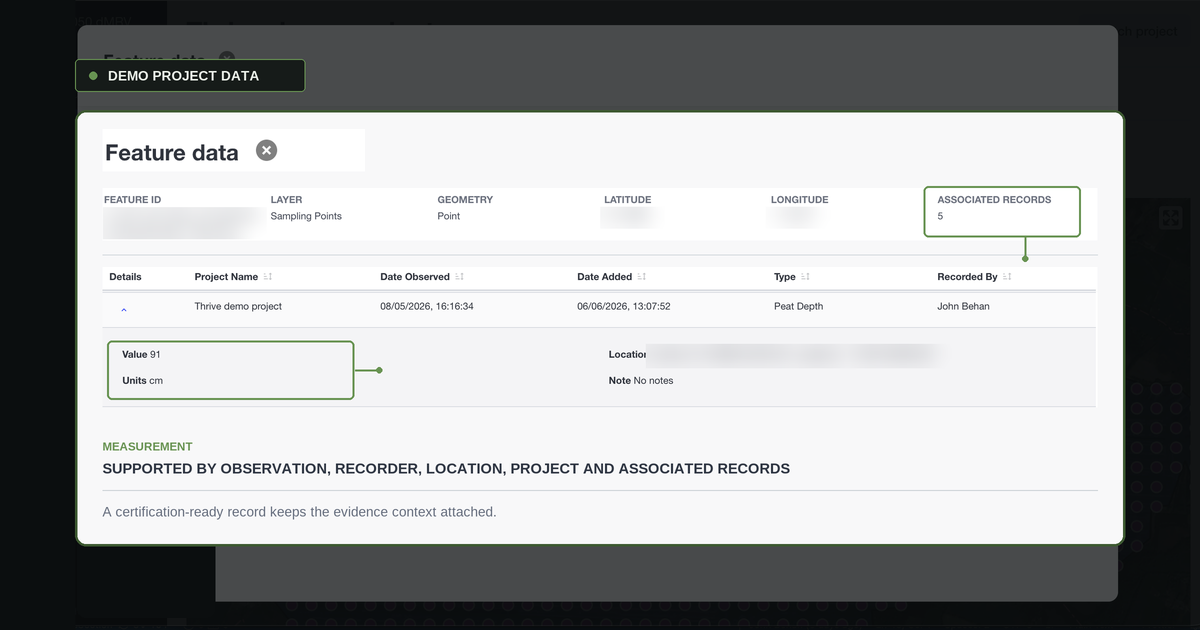
That distinction has influenced how we are building Thrive 2050. We are not just storing the 30-centimetre measurement. We want the user—and eventually the certifier—to be able to drill into it and see the evidence surrounding it: its location, its history, its provenance and how it relates to the methodology.
The individual value matters, but so does the trail behind it.
That is particularly important in the carbon market, where integrity has been called into question repeatedly over the past few years. It is not enough for a project to say that its data is accurate. Other people need to be able to inspect the basis for that claim.
For us, that means making evidence traceable and immutable, preserving its history and making it straightforward to see where it came from. It means building around the requirements of certification from the beginning, rather than collecting a large quantity of environmental data and attempting to organise it for certification afterwards.
We are not trying to replace the certifier
This is important: Thrive 2050 is not being built to replace certifiers.
The certifier’s job is essential to the integrity of the carbon market. We do not want software—or AI—making final judgments about whether project evidence is valid.
Our immediate focus is also not on persuading certifiers to abandon their existing processes and adopt an entirely new way of working. In time, we hope to work directly with standards bodies and certifiers and allow them to use the platform themselves. But we cannot base the product on everyone else changing how they work.
Right now, we are concentrating on helping project developers prepare and deliver their evidence in the format the certifier needs, aligned with the relevant standard.
The certifier still asks the questions. The certifier still assesses the evidence. The certifier still makes the decision.
We want to remove the administrative overhead that makes getting to that decision so slow and painful.
AI may help us identify trends or suggest where somebody should look more closely. It may help project developers organise their work. But it should not quietly invent values, determine whether evidence is acceptable or replace the judgment of either the developer or the certifier.
For this part of the market, that distinction matters.
Why evidence is the centre of Thrive 2050
We could have built another system for collecting and displaying environmental data. There is value in that, and there are already companies doing sophisticated work in the area.
But the problem that interests us is what happens next.
How does a project developer turn all of that material—field measurements, photographs, maps, satellite data, legal documents and everything else—into a body of evidence that a certifier can actually work through?
How do we preserve the connection between a claim and the information supporting it?
How do we reduce the endless movement of spreadsheets, folders and document versions without weakening the independent judgment on which certification depends?
That is why we are building Thrive 2050 around certification evidence.
Because gathering the data is only part of the job. If a project cannot efficiently prove what it has done, it may be delayed, become more expensive or, as we have already seen, proceed outside the carbon market altogether.
The environmental work should not have to wait for the paperwork to catch up.